


Babinski's sign (extensor plantar response)
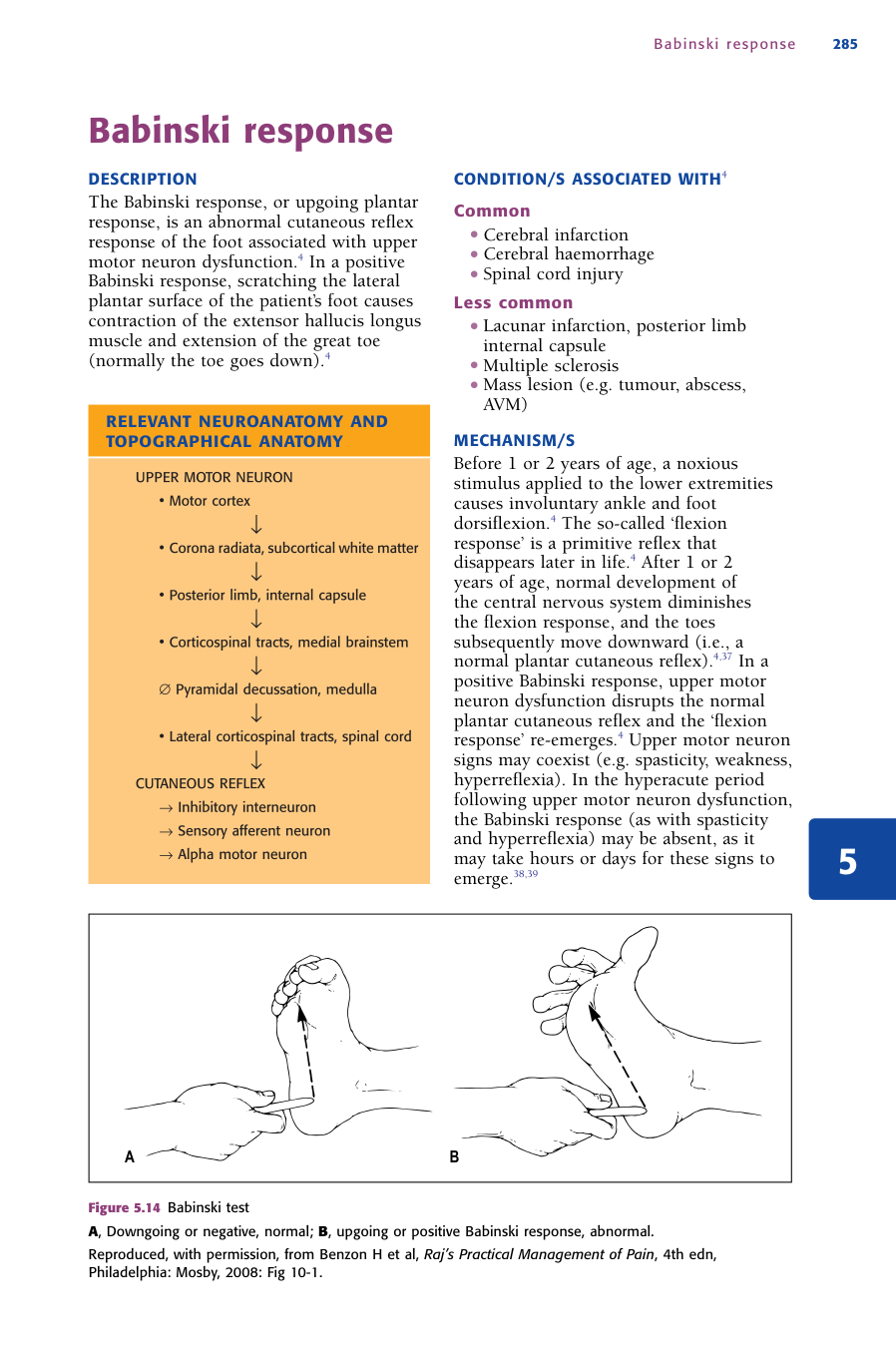

Mô tả: The Babinski response, or upgoing plantar response, is an abnormal cutaneous reflex response of the foot associated with upper motor neuron dysfunction.4 In a positive Babinski response, scratching the lateral plantar surface of the patient’s foot causes contraction of the extensor hallucis longus muscle and extension of the great toe (normally the toe goes down).4 RELEVANT NEUROANATOMY AND TOPOGRAPHICAL ANATOMY
Nguyên nhân: Common • Cerebral infarction • Cerebral haemorrhage • Spinal cord injury Less common • Lacunar infarction, posterior limb internal capsule • Multiple sclerosis • Mass lesion (e.g. tumour, abscess, AVM)
Cơ chế: Before 1 or 2 years of age, a noxious stimulus applied to the lower extremities causes involuntary ankle and foot dorsiflexion.4 The so-called ‘flexion response’ is a primitive reflex that disappears later in life.4 After 1 or 2 years of age, normal development of the central nervous system diminishes the flexion response, and the toes subsequently move downward (i.e., a normal plantar cutaneous reflex).4,37 In a positive Babinski response, upper motor neuron dysfunction disrupts the normal plantar cutaneous reflex and the ‘flexion response’ re-emerges.4 Upper motor neuron signs may coexist (e.g. spasticity, weakness, hyperreflexia). In the hyperacute period following upper motor neuron dysfunction, the Babinski response (as with spasticity and hyperreflexia) may be absent, as it may take hours or days for these signs to emerge.38,39
Ý nghĩa lâm sàng: The Babinski sign is an upper motor neuron sign. It may be absent initially in the hyperacute period following upper motor neuron dysfunction. Refer to Table 5.5. TABLE 5.5 Clinical utility of the Babinski test in patients with unilateral cerebral hemisphere lesion38 Sensitivity Specificity Positive LR Negative LR Babinski response40 45% 98% 19.0 0.6 Adapted from McGee S, Evidence Based Physical Diagnosis, 2nd edn, St. Louis: Saunders, 2007.