


Dysdiadochokinesis
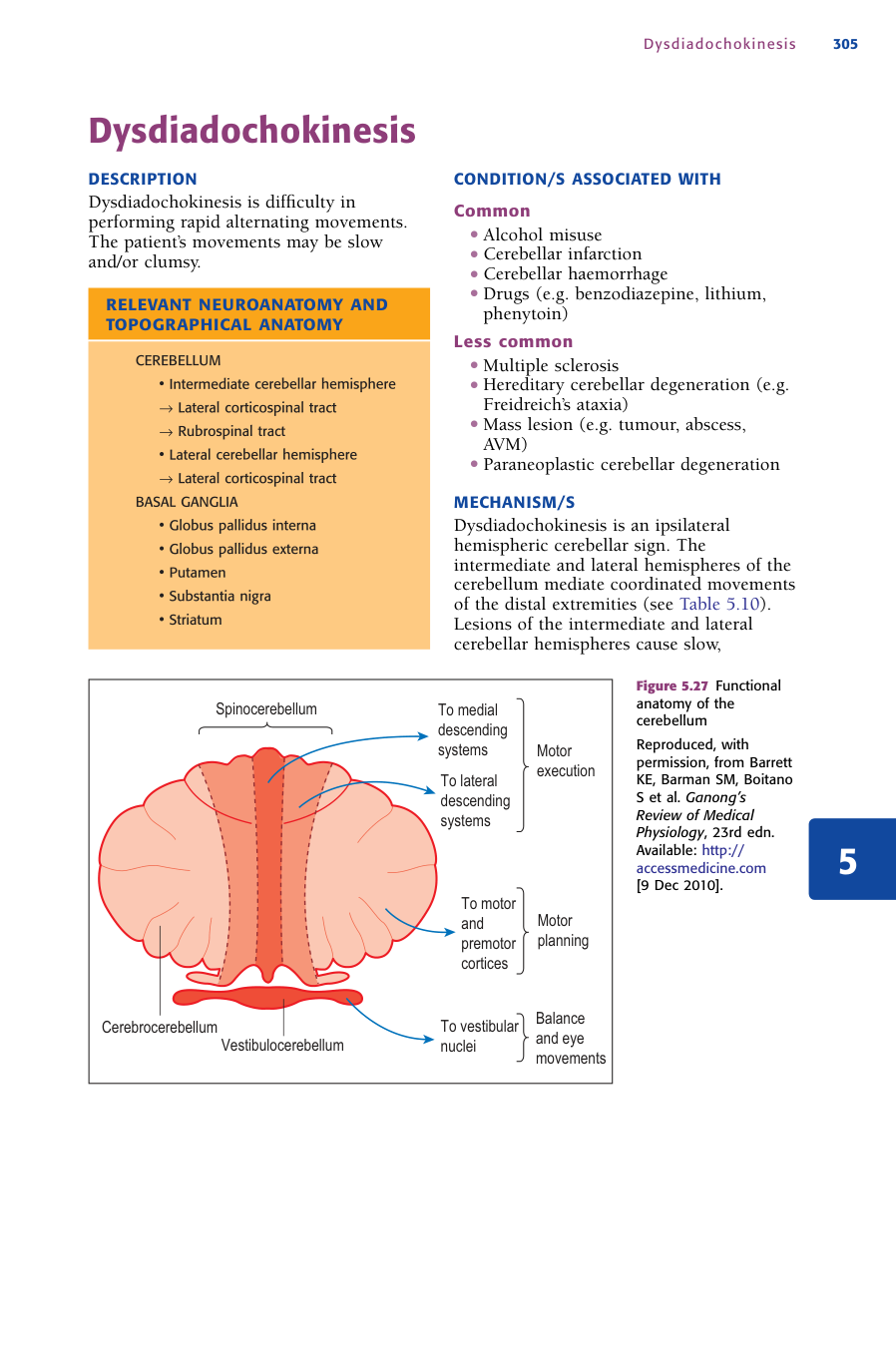
Mô tả: Dysdiadochokinesis is difficulty in performing rapid alternating movements. The patient’s movements may be slow andor clumsy. RELEVANT NEUROANATOMY AND TOPOGRAPHICAL ANATOMY To medial descending systems To lateral descending systems Motor execution To motor and premotor cortices Balance and eye movements To vestibular nuclei Motor planning Spinocerebellum Cerebrocerebellum Vestibulocerebellum
Nguyên nhân: Common • Alcohol misuse • Cerebellar infarction • Cerebellar haemorrhage • Drugs (e.g. benzodiazepine, lithium, phenytoin) Less common • Multiple sclerosis • Hereditary cerebellar degeneration (e.g. Freidreich’s ataxia) • Mass lesion (e.g. tumour, abscess, AVM) • Paraneoplastic cerebellar degeneration
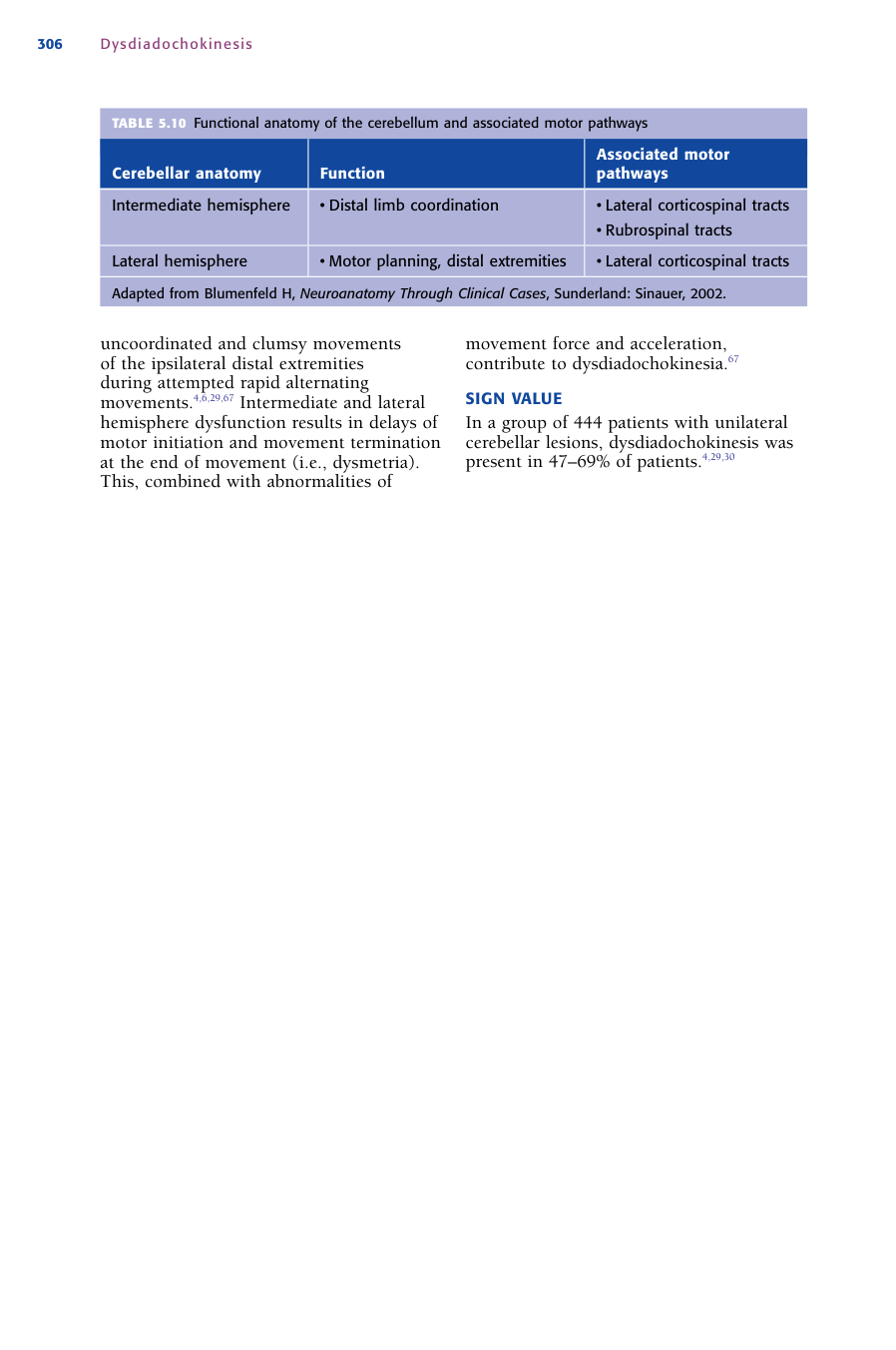
Cơ chế: Dysdiadochokinesis is an ipsilateral hemispheric cerebellar sign. The intermediate and lateral hemispheres of the cerebellum mediate coordinated movements of the distal extremities (see Table 5.10). Lesions of the intermediate and lateral cerebellar hemispheres cause slow, Dysdiadochokinesis 306 uncoordinated and clumsy movements of the ipsilateral distal extremities during attempted rapid alternating movements.4,6,29,67 Intermediate and lateral hemisphere dysfunction results in delays of motor initiation and movement termination at the end of movement (i.e., dysmetria). This, combined with abnormalities of movement force and acceleration, contribute to dysdiadochokinesia.67
Ý nghĩa lâm sàng: In a group of 444 patients with unilateral cerebellar lesions, dysdiadochokinesis was present in 47–69% of patients.4,29,30 TABLE 5.10 Functional anatomy of the cerebellum and associated motor pathways Cerebellar anatomy Function Associated motor pathways Intermediate hemisphere • Distal limb coordination • Lateral corticospinal tracts • Rubrospinal tracts Lateral hemisphere • Motor planning, distal extremities • Lateral corticospinal tracts Adapted from Blumenfeld H, Neuroanatomy Through Clinical Cases, Sunderland: Sinauer, 2002.