


Dysphonia
Mô tả: Dysphonia is a disorder of phonation (i.e., sound production) due to dysfunction of the larynx andor vocal cords.69 The patient’s voice may sound hoarse, weak, excessively breathy, harsh or rough.69
Nguyên nhân: Common • Viral laryngitis • Vocal cord polyp • Iatrogenic (e.g. prolonged endotracheal intubation) Less common • Tumour (e.g. squamous cell carcinoma) • Recurrent laryngeal nerve palsy (e.g. iatrogenic, Pancoast’s tumour, penetrating neck trauma, thoracic aortic aneurysm) • Laryngospasm • Lateral medullary syndrome (Wallenberg’s syndrome)
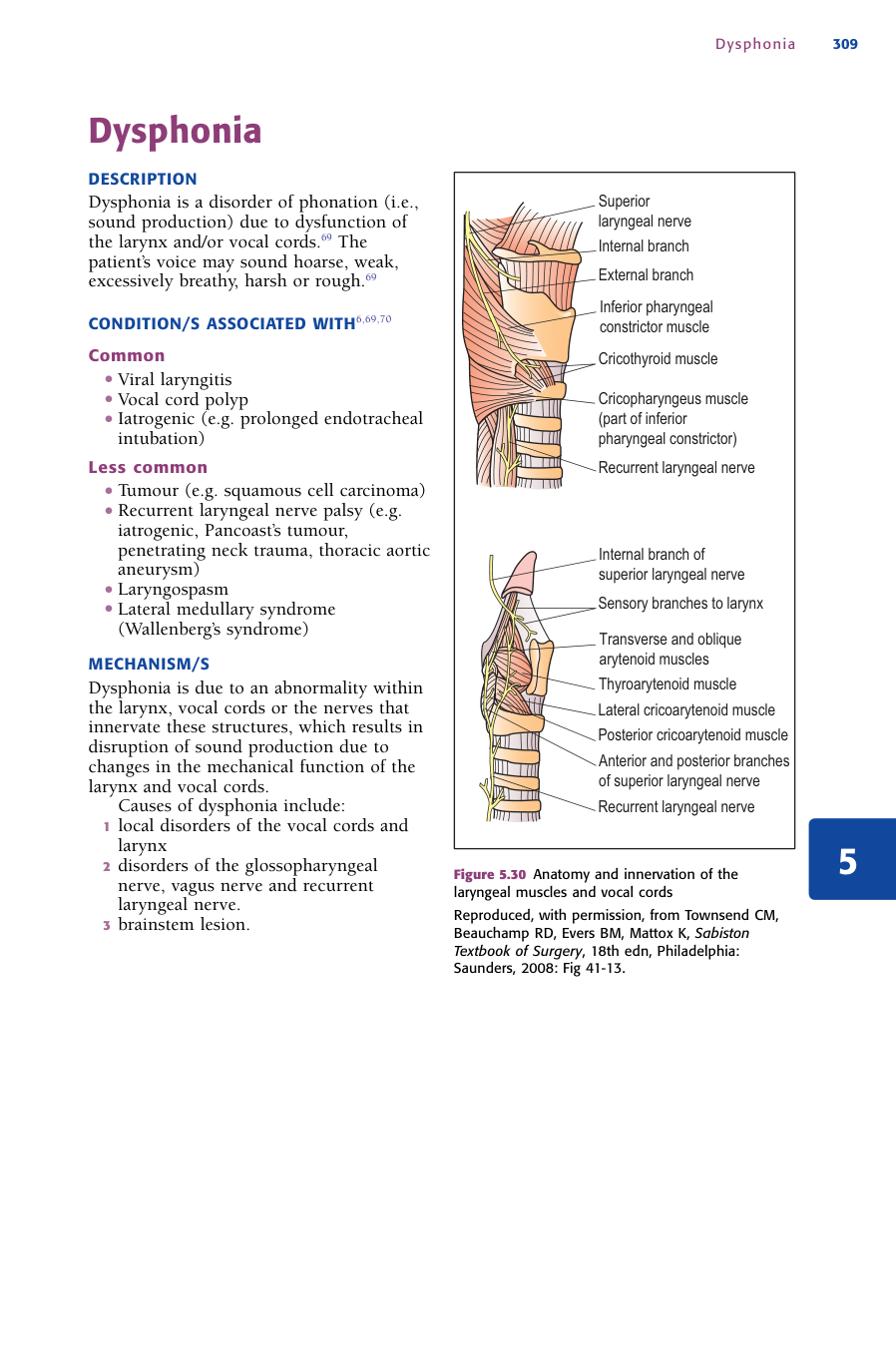
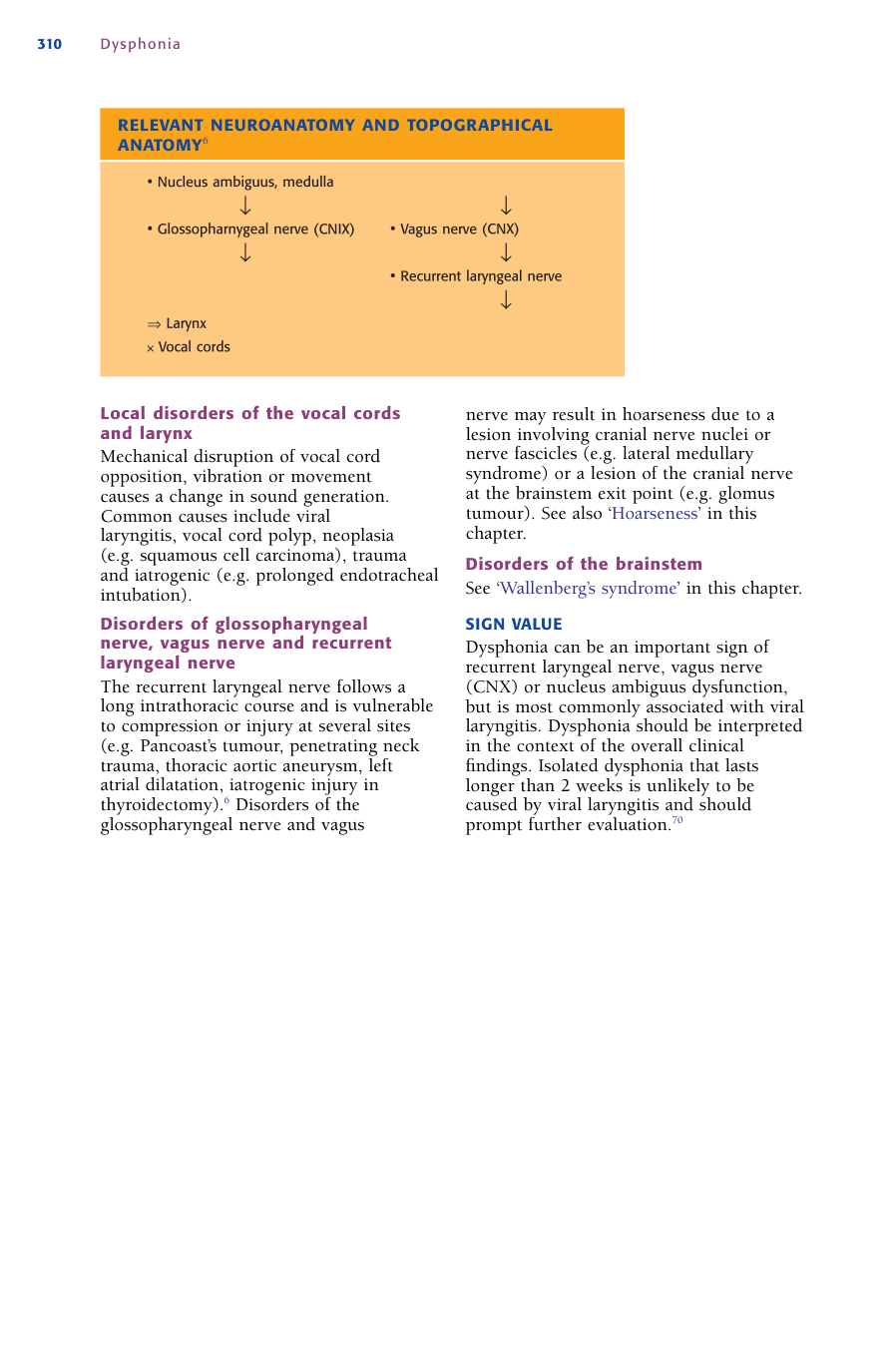
Cơ chế: Dysphonia is due to an abnormality within the larynx, vocal cords or the nerves that innervate these structures, which results in disruption of sound production due to changes in the mechanical function of the larynx and vocal cords. Causes of dysphonia include: 1 local disorders of the vocal cords and larynx 2 disorders of the glossopharyngeal nerve, vagus nerve and recurrent laryngeal nerve. 3 brainstem lesion. Dysphonia 310 Local disorders of the vocal cords and larynx Mechanical disruption of vocal cord opposition, vibration or movement causes a change in sound generation. Common causes include viral laryngitis, vocal cord polyp, neoplasia (e.g. squamous cell carcinoma), trauma and iatrogenic (e.g. prolonged endotracheal intubation). Disorders of glossopharyngeal nerve, vagus nerve and recurrent laryngeal nerve The recurrent laryngeal nerve follows a long intrathoracic course and is vulnerable to compression or injury at several sites (e.g. Pancoast’s tumour, penetrating neck trauma, thoracic aortic aneurysm, left atrial dilatation, iatrogenic injury in thyroidectomy).6 Disorders of the glossopharyngeal nerve and vagus nerve may result in hoarseness due to a lesion involving cranial nerve nuclei or nerve fascicles (e.g. lateral medullary syndrome) or a lesion of the cranial nerve at the brainstem exit point (e.g. glomus tumour). See also ‘Hoarseness’ in this chapter. Disorders of the brainstem See ‘Wallenberg’s syndrome’ in this chapter.
Ý nghĩa lâm sàng: Dysphonia can be an important sign of recurrent laryngeal nerve, vagus nerve (CNX) or nucleus ambiguus dysfunction, but is most commonly associated with viral laryngitis. Dysphonia should be interpreted in the context of the overall clinical findings. Isolated dysphonia that lasts longer than 2 weeks is unlikely to be caused by viral laryngitis and should prompt further evaluation.70 RELEVANT NEUROANATOMY AND TOPOGRAPHICAL ANATOMY6