


Parkinsonian tremor
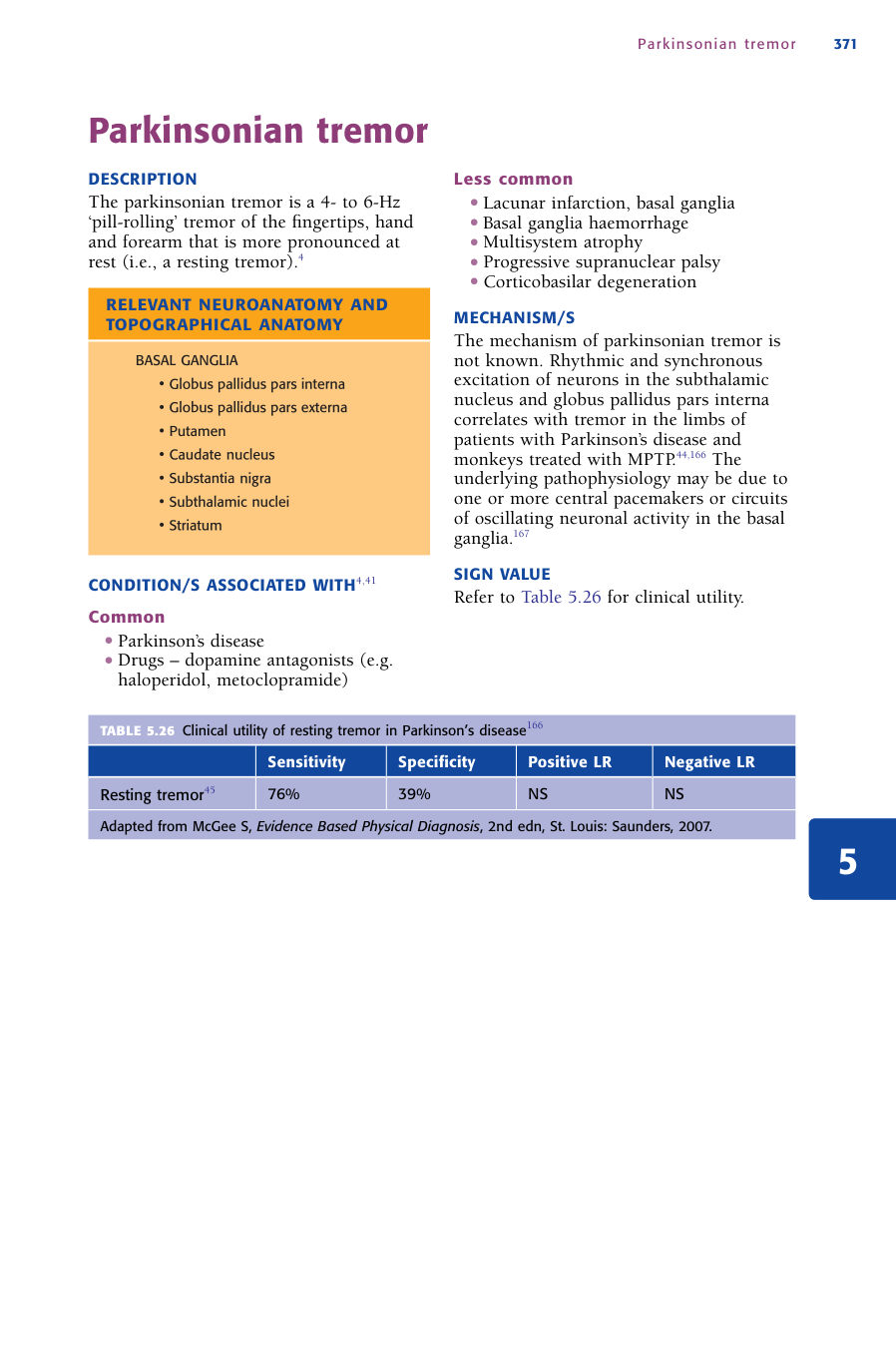
Description: The parkinsonian tremor is a 4- to 6-Hz ‘pill-rolling’ tremor of the fingertips, hand and forearm that is more pronounced at rest (i.e., a resting tremor).4 RELEVANT NEUROANATOMY AND TOPOGRAPHICAL ANATOMY
Conditions Associated: Common • Parkinson’s disease • Drugs – dopamine antagonists (e.g. haloperidol, metoclopramide) Less common • Lacunar infarction, basal ganglia • Basal ganglia haemorrhage • Multisystem atrophy • Progressive supranuclear palsy • Corticobasilar degeneration
Mechanism/S: The mechanism of parkinsonian tremor is not known. Rhythmic and synchronous excitation of neurons in the subthalamic nucleus and globus pallidus pars interna correlates with tremor in the limbs of patients with Parkinson’s disease and monkeys treated with MPTP.44,166 The underlying pathophysiology may be due to one or more central pacemakers or circuits of oscillating neuronal activity in the basal ganglia.167
Sign Value: Refer to Table 5.26 for clinical utility. TABLE 5.26 Clinical utility of resting tremor in Parkinson’s disease166 Sensitivity Specificity Positive LR Negative LR Resting tremor45 76% 39% Adapted from McGee S, Evidence Based Physical Diagnosis, 2nd edn, St. Louis: Saunders, 2007.